
WTW Meaning in Text | What Does WTW Mean?
WTW meaning in text usually refers to “What’s the word?” as a casual way to ask what is happening. The WTW full form is commonly used in texts, chats, and social media messages. It can also mean asking what someone is doing or what plans they have.
In WTW in text messages, the phrase often works as a friendly check-in or conversation starter. The meaning can shift slightly based on the topic, tone, and relationship between the people chatting. You may see WTW in group chats, Snapchat messages, Instagram DMs, and other casual conversations.
This article explains the WTW slang meaning, common WTW examples, and natural ways to reply. You will also learn when to use WTW and how its tone can change in different conversations.
What Does WTW Mean in Text?
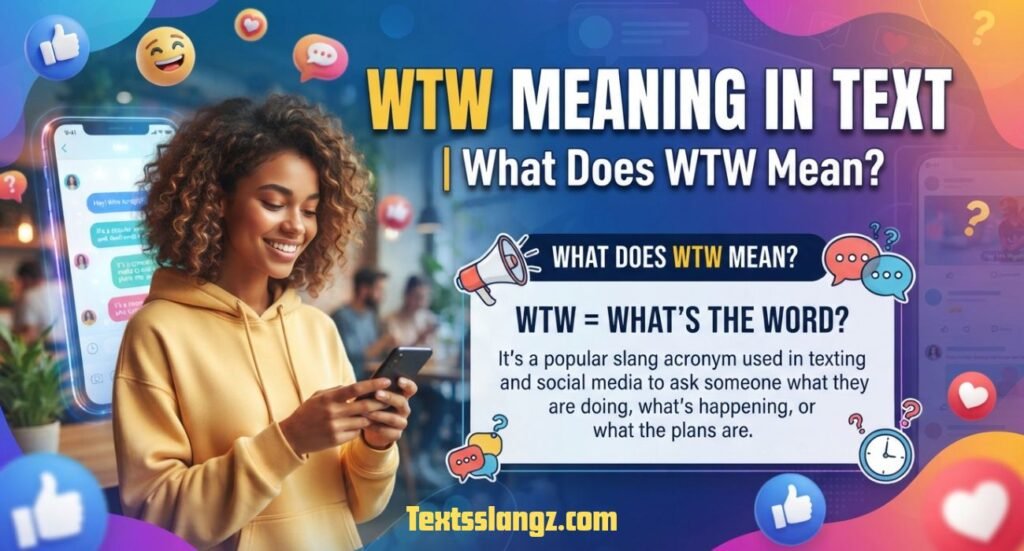
WTW means “What’s the word?” when used as texting slang. It usually asks someone what is going on, what they are up to, or whether they have any plans.
For example:
Person A: “WTW tonight?”
Person B: “Nothing planned yet. You?”
Here, WTW is asking about the plans for the evening.
The phrase is similar to saying “What’s going on?”, “What are you up to?”, or “What are the plans?” The short form makes the message quicker and more casual.
Read Also:
WTW Full Form and Slang Meaning
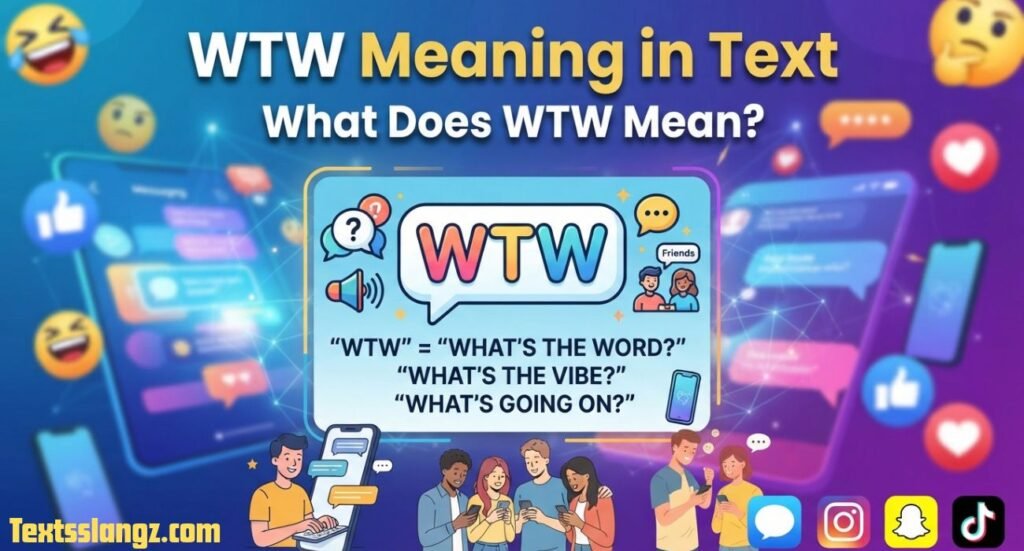
The most common WTW full form in casual texting is “What’s the word?” It is a texting abbreviation used to start or continue a casual conversation.
In this expression, “the word” does not usually mean a specific word from a dictionary. Instead, it can mean the latest news, plans, situation, or update.
For example:
“WTW? Haven’t heard from you all day.”
This can mean, “What’s going on?” or “What have you been up to?”
WTW is therefore best understood as a flexible casual slang expression rather than a phrase with only one possible interpretation.
How Context Changes the WTW Meaning
The WTW meaning can change depending on the topic of the conversation. Most of the time, “What’s the word?” is the intended meaning, but context helps confirm it.
If a friend sends “WTW?” without any other information, they may simply be checking in. If you were already discussing weekend plans, the same message may specifically ask what everyone wants to do.
For example:
- After school: “WTW after class?” can ask about plans.
- Before a party: “WTW for tonight?” can ask what is happening.
- After a long silence: “WTW?” can mean “What’s going on?”
- In a group chat: “WTW everyone?” can invite people to share their plans.
The relationship between the speakers also matters. A message from a close friend usually sounds more relaxed than the same abbreviation from someone you barely know.
What Does WTW Mean on Different Platforms?
WTW generally has the same casual meaning across social media platforms, although the surrounding conversation can change how readers understand it.
Text Messages
In text messages, WTW is commonly used as a quick check-in.
Example:
“WTW this weekend?”
The sender is probably asking what plans are coming up.
Snapchat
The WTW meaning on Snapchat is usually “What’s the word?” It can be used when someone wants to start a conversation or ask what is happening.
Example:
“WTW 👀”
Depending on the conversation and emoji, this could simply invite an update or ask about plans.
On Instagram, WTW can appear in DMs, comments, or casual conversations. In a DM, it often works as a short conversation starter.
Example:
“WTW for Friday?”
This most likely means, “What are the plans for Friday?”
Group Chats
WTW in group chats can be directed at everyone instead of one person.
Example:
“WTW tonight, everyone?”
The sender wants to know what the group is doing or whether anyone has plans.
WTW Examples in Real Conversations
These WTW examples show how the abbreviation can work in different everyday situations.
1: Friends Making Plans
Alex: “WTW Saturday?”
Jordan: “I’m free after 5. Want to grab food?”
Meaning: Alex is asking what the plans are for Saturday.
2: Casual Check-In
Mia: “WTW? You disappeared 😂”
Sam: “Haha, I’ve been busy with homework.”
Meaning: Mia is casually asking what is going on.
3: Group Chat
Chris: “WTW everyone?”
Taylor: “Movie at my place?”
Chris: “I’m in.”
Meaning: Chris is asking the group about possible plans.
EVERY MEANING OF WTW
WTW does not have one universal meaning in every conversation. The surrounding words usually reveal what the sender intends.
“What’s the Word?” — The Default
“What’s the word?” is the most useful meaning to know when you see WTW in casual texting.
It can function as a casual check-in, conversation starter, or question about plans. Depending on context, it may be understood as “What’s going on?” or “What are you up to?”
“What the What?” — The Surprise
WTW can sometimes be interpreted as “What the what?”, especially when someone is reacting to something unexpected.
For example:
Person A: “I accidentally sent the message to the wrong group.”
Person B: “WTW 😭”
Here, WTW could express surprise or confusion rather than ask about plans.
This meaning is less straightforward than “What’s the word,” so the surrounding conversation matters.
“What to Watch” and “What to Wear”
In some conversations, WTW can stand for “What to Watch” or “What to Wear.” These meanings are highly dependent on context.
For example:
“WTW tonight?” while discussing movies could mean “What to watch tonight?”
Similarly, someone discussing an outfit might use WTW to mean “What to wear?”
These interpretations are not usually the default. Look at the topic before deciding what the abbreviation means.
HOW TO REPLY TO WTW
The best way to reply to WTW depends on what the sender appears to be asking.
If they are asking about plans, give your plans or suggest something. If they are simply checking in, tell them what you are doing.
Example:
Friend: “WTW?”
You: “Not much. Just relaxing. What about you?”
Or:
Friend: “WTW Friday?”
You: “I’m free after 6. Want to hang out?”
Reply Examples
Here are some natural WTW replies:
- “Not much, you?”
- “Just chilling. What’s up?”
- “I’m free tonight. What are you thinking?”
- “Nothing planned yet.”
- “I’m studying right now.”
- “Probably staying home.”
- “I’m down. What’s the plan?”
- “Not sure yet. Any ideas?”
A good reply should match the question and the relationship you have with the sender.
Is WTW Rude?
WTW is not normally rude. It is a casual abbreviation used in informal communication.
However, tone depends on context. A short message such as “WTW?” can feel abrupt if it comes from someone you do not know well or appears in a formal conversation.
With friends, it is generally relaxed and conversational. In professional communication, a complete phrase such as “What are the plans?” or “What’s going on?” is usually clearer.
Is WTW Flirty?
WTW is not inherently flirty. By itself, the abbreviation normally works as a casual conversation starter.
It can appear in a flirty conversation, but the surrounding messages, relationship, emojis, and tone create that meaning.
For example, “WTW tonight? 😉” may feel more playful than a simple “WTW?” However, the abbreviation itself does not automatically communicate romantic interest.
How to Reply to WTW
When someone sends WTW, first consider what they are probably asking. If they want an update, explain what you are doing. If they are asking about plans, give a specific answer.
You can also ask them what they have in mind if you are unsure.
Friendly Replies
Friendly replies can stay short and natural:
- “Not much! How about you?”
- “Just hanging out.”
- “I’m free later.”
- “Nothing planned yet.”
- “Just finished school.”
- “I’m around. What’s up?”
Funny Replies
If the conversation is playful, you can use a humorous response:
- “The word is pizza.”
- “The word is… snacks.”
- “Currently accepting plans.”
- “The word is ‘sleep.’”
- “Same old story 😂”
These replies work best when you already have a relaxed relationship with the person.
Replies When You Are Confused
Sometimes you may not know which WTW meaning the sender intended. You can ask directly:
- “What do you mean by WTW?”
- “You mean what’s the word?”
- “Are you asking what I’m doing?”
- “Do you mean plans for tonight?”
Asking for clarification is better than guessing when the context is unclear.
Read Also:
When to Use WTW
Use WTW when you are having a casual conversation with friends, classmates, relatives, or other people who understand texting slang.
It works well for:
- Asking what someone is doing
- Checking what the plans are
- Starting a casual conversation
- Asking for an update
- Joining a group conversation
- Talking about weekend or evening plans
WTW fits naturally in text messages, social media chats, and informal DMs.
When to Avoid WTW
Avoid WTW when the conversation requires a professional or formal tone.
For example, you would usually not write “WTW?” in a formal email to a manager, teacher, customer, or business contact. A clear sentence is more appropriate in formal communication.
Instead, you could write:
- “What are the plans for tomorrow?”
- “Could you please share the latest update?”
- “What should we expect next?”
The goal is clarity. Casual slang is useful when both people understand it, but formal communication often benefits from complete wording.
Common Mistakes About WTW
| Common Mistake | Correct Understanding |
| WTW always means one thing | Meaning depends on context |
| WTW is always flirty | It is usually casual, not automatically flirty |
| WTW is rude | It is generally friendly and informal |
| WTW only means “What’s the word?” | Other meanings can exist in specific contexts |
| Everyone understands WTW | Some people may not know the abbreviation |
| WTW is suitable for formal messages | Use complete phrases in professional communication |
Another common mistake is thinking that a short message always has a deeper meaning. Often, the sender simply wants to know what you are doing or what is happening.
Similar Slang Terms
Several casual texting abbreviations can serve a similar purpose:
- WSG — commonly means “What’s good?”
- WYO — commonly means “What you on?”
- WYD — commonly means “What you doing?”
- WYA — commonly means “Where you at?”
These terms are related because they can start a casual conversation or ask for an update. Their exact use still depends on context.
For example, WYD focuses more directly on what someone is doing, while WYA asks about their location. WTW is broader and can ask what is happening or what plans are being discussed.
Where Does WTW Come From?
WTW developed as part of the broader use of shortened language in informal digital communication. People often shorten familiar phrases to make messages quicker and easier to type.
The abbreviation is commonly understood as “What’s the word?” in casual texting, where the phrase itself acts as a conversational prompt.
There is no need to assume that every use of WTW has the same origin or meaning. Different online communities can use abbreviations differently, so context remains the best guide.
Quick Recap
The most common WTW meaning in text is “What’s the word?” It is a casual way to ask what is happening, what someone is doing, or what the plans are.
WTW is common in text messages, Snapchat, Instagram DMs, group chats, and other informal conversations. It is usually friendly rather than rude and is not automatically flirty.
If someone sends “WTW?”, you can answer with your current plans, explain what you are doing, or simply ask what they have in mind. When the context is unclear, asking for clarification is the safest choice.
FAQ,S
What does “WTW” mean in slang?
“WTW” usually means “What’s the word?” in slang. It can also mean “What’s the move?” depending on the conversation.
What does WTW mean from a girl?
When a girl texts “WTW,” she may be asking “What’s the word?” or “What are you up to?” It often starts a casual conversation.
What does WTW stand for?
WTW commonly stands for “What’s the word?” In some chats, it can also mean “What’s the move?”
How do I reply to WTW?
You can reply with something like “Not much, what’s up?” or “Just chilling, what’s the move?”
What does “WTW” mean in a chat?
In a chat, “WTW” is usually a casual way to ask what’s happening or what the plan is. Its exact meaning depends on the context.
Conclusion
WTW is a common slang term used in texts, chats, and social media. The WTW Meaning in Text usually refers to “What’s the word?” or “What’s the move?” People use it to ask about plans, activities, or what is happening. The exact meaning can change based on the conversation. Knowing the context helps you understand the message correctly. WTW often has a friendly and casual tone, so it works well in everyday online conversations.
Understanding WTW can make texting easier and clearer. If someone sends WTW, you can give a simple reply about what you are doing or what you plan to do. You can also ask about their plans in a natural way. WTW is short, simple, and useful in modern digital communication. Learning common slang terms helps you follow online conversations with confidence.


2 Comments