

SOS Meaning | The Complete Guide to the Universal Distress Signal
SOS meaning refers to an internationally recognized distress signal that people use to ask for urgent help. It does not have an official full form, but it represents a clear message of danger or need. Its Morse code pattern uses three dots, three dashes, and three dots to communicate distress.
In everyday conversations, people also use SOS to express stress, frustration, or a playful need for help. The SOS meaning in text can sound serious or casual, depending on the situation and the sender’s tone. On social media and platforms like TikTok, Snapchat, and WhatsApp, it often works as a quick way to ask for support.
This article explains what SOS stands for, where the signal comes from, and how people use it today. You will also find simple examples of SOS in texting, relationships, and everyday situations. It covers the SOS meaning on iPhone, common misunderstandings, and helpful ways to respond.
Quick Answer
SOS is an internationally recognized distress signal used to request urgent help during an emergency. It is best known for its Morse code pattern of three dots, three dashes, and three dots (... --- ...).
In texting and online conversations, SOS often has a more casual meaning. People use it to ask for help, express frustration, or show that they feel overwhelmed. For example, someone might text, “SOS, I have three assignments due tomorrow!” to show that they need assistance.
| Aspect | Meaning |
|---|---|
| Full form | SOS has no official full form |
| Main meaning | International distress signal |
| Morse code | Three dots, three dashes, three dots |
| Texting meaning | Help me or I need assistance |
| Tone | Serious, playful, or urgent |
| Common use | Emergencies, chats, and social media |
What Does SOS Mean?
SOS means a request for immediate help or assistance. Its original purpose is to communicate distress when someone faces a dangerous situation and needs rescue.
The signal became internationally recognized because its Morse code pattern is simple and easy to identify. It does not depend on spoken language, which makes it useful for emergency communication across different countries.
Today, people also use SOS in everyday conversations. A student might send it before an important exam, while someone else might use it when they need advice about a difficult situation.
Read Also: Unc Meaning Slang | The Complete Guide to This Viral Term
The Morse Code Connection
SOS is famous for its distinctive Morse code pattern:
- S: Three dots (
...) - O: Three dashes (
---) - S: Three dots (
...)
… — …
S
Three dots
O
Three dashes
S
Three dots
Together, the pattern looks like this:
The internationally recognized SOS Morse code pattern.
This pattern is easy to recognize because it has a clear rhythm. It can be transmitted using radio signals, flashing lights, or sound signals.
An important detail is that Morse code represents letters through short and long signals. The SOS pattern does not need spaces between its individual letters when transmitted as the recognized distress signal.

The True Origin
SOS became an international maritime distress signal in 1906 through an agreement at the International Radiotelegraph Convention in Berlin. It was selected because its Morse code pattern was simple and easy to recognize.
The signal came into practical use for maritime emergencies in the early 20th century. It replaced earlier distress signals, including CQD, which had been used by some radio operators.
Although many people associate SOS with phrases such as “Save Our Souls” and “Save Our Ship,” these expressions were created as memorable explanations after the signal became known. They were not the original meaning behind its selection.
Full Definition
SOS is a universal distress signal that communicates a serious need for help. Its official use is connected to emergency communication, especially situations where people need rescue or immediate assistance.
Outside emergencies, the same three letters can communicate a less serious request. The exact meaning depends on the situation and the relationship between the people communicating.
Official Definition
The official meaning of SOS is an internationally recognized distress signal used to indicate grave and imminent danger.
It is especially associated with maritime communication, where ships can use the signal to request assistance. It can also be recognized in other emergency communication situations.
The signal itself does not explain the type of danger. It simply communicates that an urgent emergency exists and help is needed.
For example:
“Mayday! Mayday! We are sending an SOS signal.”
This indicates a serious emergency rather than an ordinary request for help.
Broader Meaning
In everyday communication, SOS has a broader meaning. It can express a need for assistance, support, advice, or attention.
People use it in different situations, including:
- School: Asking for help with difficult homework.
- Work: Requesting assistance with an urgent task.
- Relationships: Seeking advice about a confusing situation.
- Friendships: Asking someone to help solve a problem.
- Social media: Expressing frustration in a funny or dramatic way.
For example, “SOS, I cannot understand this math question” is a casual request for help.
The emergency meaning remains important, but everyday use is usually less serious.
What SOS Does NOT Stand For
A common misconception is that SOS officially stands for “Save Our Souls” or “Save Our Ship.”
Neither phrase is the original or official full form. SOS was selected because of its distinctive Morse code pattern, not because the letters represented a particular English sentence.
| Common belief | Actual explanation |
|---|---|
| Save Our Souls | Popular later interpretation |
| Save Our Ship | Popular maritime interpretation |
| Save Our Soldiers | Not the official meaning |
| SOS has an official full form | It does not have one |
Therefore, when someone asks what SOS stands for, the most accurate answer is that it is a recognized distress signal rather than an abbreviation with an official expanded form.
Context and Usage
SOS can communicate different messages depending on where and how someone uses it. In an emergency, it indicates a serious need for rescue. In a text message, it usually communicates that someone needs help or feels overwhelmed.
Understanding the surrounding conversation helps you identify the intended meaning.
Serious Emergency Context
In a serious emergency, SOS communicates that someone is in danger and requires immediate assistance.
It is historically associated with ships and maritime distress communication. However, people also recognize it as a general symbol of an urgent request for help.
For example:
“Our boat has lost communication and needs immediate assistance. SOS!”
This is a serious use of the signal. It should not be confused with casual internet slang.
In an actual emergency, contact the appropriate emergency services whenever possible. Do not rely on sending an SOS message alone.
Casual and Playful Context
In everyday conversations, SOS is often used humorously. People send it when they need advice, feel stressed, or want someone to help them handle a situation.
Examples include:
- “SOS, I forgot about tomorrow’s presentation.”
- “Someone send SOS. My little brother keeps bothering me.”
- “SOS! I have no idea what to wear for the school event.”
These messages are not necessarily emergencies. They are usually playful ways to express frustration or ask for assistance.
The tone may become more serious when someone describes a genuine problem or asks for immediate support.
The Slang Evolution
SOS has gradually become a familiar expression in digital communication. People use it in text messages, comments, group chats, and social media captions.
As internet slang, it can communicate several feelings:
- Feeling overwhelmed: “SOS, I have too much work.”
- Needing advice: “SOS, what should I reply?”
- Expressing frustration: “SOS, my internet stopped working.”
- Making a joke: “SOS, I finished all the snacks.”
It is not limited to one generation or social media platform. Its meaning is generally easy to understand because it connects to the familiar idea of asking for help.
Real-Life Examples
The following examples show how people use SOS in different situations. Some are serious, while others express ordinary problems in a playful way.
1: Serious Emergency
Person A: “We are stranded and need immediate assistance. SOS!”
Person B: “Contact emergency services and share your exact location.”
Meaning: SOS communicates a genuine need for urgent help.
2: Academic Overwhelm
Student A: “SOS, I have a science test tomorrow and still have two chapters to study.”
Student B: “Let’s review the important topics together.”
Meaning: The student feels overwhelmed and wants academic support.
3: Relationship Drama
Person A: “SOS, my friend misunderstood my message. What should I say?”
Person B: “Explain what you meant calmly and give them a chance to respond.”
Meaning: The sender wants advice about a personal situation.
4: Workplace Warning
Employee A: “SOS, the presentation file is not opening, and the meeting starts soon.”
Employee B: “Send me the file. I’ll check it.”
Meaning: The employee needs quick technical assistance.
5: Group Chat Reaction
Friend A: “SOS, I just realized we have a group assignment due tomorrow.”
Friend B: “How did we all forget?”
Meaning: SOS expresses surprise and playful frustration in a group conversation.
Platform-Specific Meaning
SOS generally keeps the same basic meaning across social media platforms. However, the situation in which someone uses it can change its tone.
It may be a serious request for help, a funny reaction, or a simple way to get someone’s attention.
SOS on WhatsApp
On WhatsApp, SOS usually means “I need help” or “Please help me.”
People use it in private chats and group conversations when they need quick assistance.
Examples:
- “SOS, can you help me with this assignment?”
- “SOS, I need your advice about something.”
- “Someone call me, SOS!”
The meaning depends on the message. A funny conversation may make it playful, while a message describing danger should be taken seriously.
SOS on Snapchat
On Snapchat, SOS is commonly understood as a quick request for help or attention.
Someone might send it in a snap caption, direct message, or conversation with friends.
Examples:
- “SOS, I have nothing to post today.”
- “SOS, help me choose a picture.”
- “SOS, my parents are asking too many questions.”
It does not have a separate official Snapchat definition. It generally carries the same meaning as it does in ordinary texting.
SOS on TikTok
On TikTok, SOS can appear in captions, comments, and videos.
Creators may use it to express frustration, ask for suggestions, or react dramatically to funny situations.
Examples:
- “SOS, this trend is harder than it looks.”
- “SOS, I cannot stop watching these videos.”
- “Someone help me understand this situation.”
On TikTok, the expression often has a humorous or exaggerated tone. However, the surrounding content still determines whether the request is serious.
SOS on iPhone
On an iPhone, SOS can have a technical meaning rather than a texting meaning.
When the status bar displays SOS or SOS Only, it generally indicates that the iPhone cannot connect to its regular cellular network but may still be able to make emergency calls through an available supported network.
This does not mean that the phone is automatically sending a distress signal.
iPhone Showing SOS? Here’s Why – MacRumors
Common reasons for seeing SOS or SOS Only include:
- Your regular cellular network is unavailable.
- You are in an area with poor cellular coverage.
- Your carrier is experiencing a service interruption.
- Your SIM or cellular account has a connection problem.
You can try these steps:
- Move to an area with better cellular coverage.
- Turn Airplane Mode on and off.
- Restart your iPhone.
- Check whether your cellular plan and SIM are active.
- Contact your carrier if the problem continues.
The iPhone also has an Emergency SOS feature. It allows users to contact emergency services through supported emergency calling options.
These are two different things: SOS in the status bar indicates a cellular connection limitation, while Emergency SOS is a safety feature.
Read Also: PRN Meaning | What Does PRN Mean in Text and Slang?
How Can You Signal SOS Without a Radio?
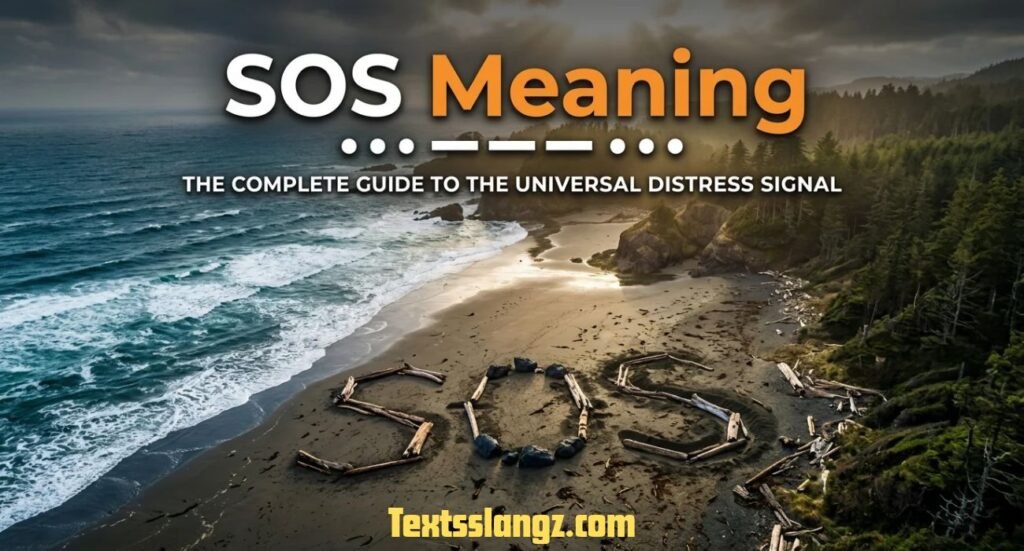
You can communicate SOS without a radio by using other recognizable signals. The traditional Morse code pattern can be represented through light, sound, or visible movements.
Some possible methods include:
- Flashlight: Use three short flashes, three long flashes, and three short flashes.
- Whistle: Produce three short sounds, three longer sounds, and three short sounds.
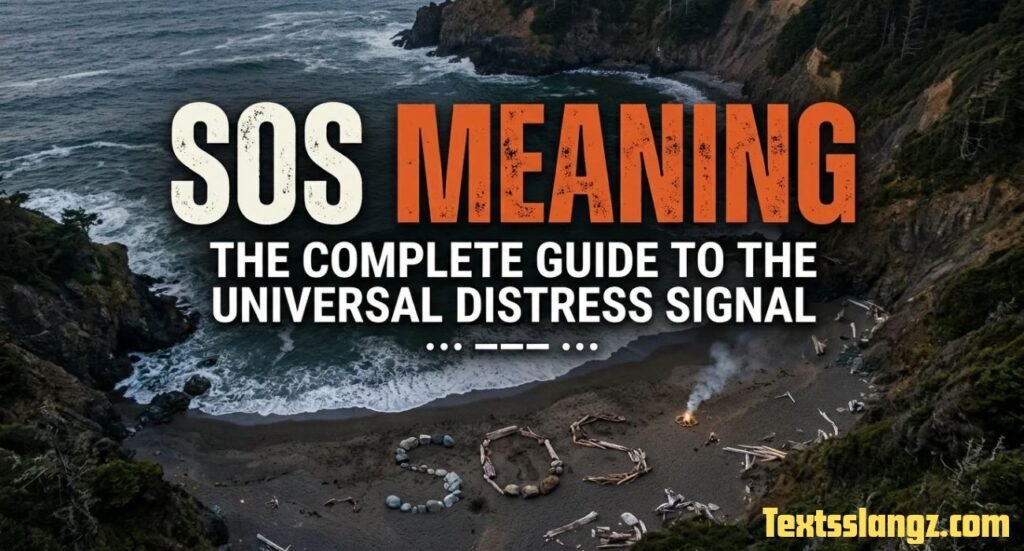
- Visual signal: Display the letters SOS using large, visible markings.
- Mirror reflection: Use reflected sunlight to attract attention when conditions allow.
Building Signal Structures: How to Use Visible Signs for Wilderness Rescue | Inside Survival
In an outdoor emergency, making yourself visible to rescuers can be helpful. Use available emergency equipment and contact local emergency services whenever possible.
Remember that SOS is a distress signal, not a guarantee that someone will receive your message. Choose the safest available method of communication.
Alternative Meanings
Although SOS is mainly recognized as a distress signal, the letters can have different interpretations in informal conversations and specialized settings.
Some expressions are established alternative phrases, while others are jokes, personal abbreviations, or context-specific uses.
Same Old Stuff
“Same Old Stuff” is an informal interpretation of SOS.
Someone may use it when describing a repetitive situation or something that has not changed.
Example:
Person A: “What’s new with you?”
Person B: “SOS. Same routine as always.”
Meaning: Nothing interesting or different has happened.
This is a casual interpretation, not the official meaning of the distress signal.
Someone On Shoulder / Someone Over Shoulder
Some people use SOS to refer to “Someone Over Shoulder.”
It describes a situation in which another person is nearby and may be able to see someone’s screen or conversation.
Example:
Person A: “SOS, my teacher is standing behind me.”
Person B: “Okay, talk later!”
Meaning: The sender is warning the other person that someone is watching.
“Someone on Shoulder” is not a standard expansion. “Someone Over Shoulder” is the more recognizable interpretation.
Save Our Ship / Save Our Souls
“Save Our Ship” and “Save Our Souls” are two popular explanations associated with SOS.
Both phrases communicate the idea of requesting rescue or protection during danger.
However, neither is the official full form. They are commonly used as memory aids because they connect naturally with the distress signal’s purpose.
Shit on a Shingle
“Shit on a Shingle” is an informal American expression sometimes shortened to SOS.
It refers to a traditional military-style food dish consisting of creamed meat served over toast or bread.
This meaning has nothing to do with emergency communication. It is a separate use of the same letters.
Same Old Shit
In informal conversations, SOS may also be used as a shortened form of “Same Old Shit.”
It describes a repetitive or frustrating situation.
Example:
Person A: “How is everything going?”
Person B: “SOS. Nothing has changed.”
Meaning: Things are still the same as before.
This expression is informal and contains profanity, so it is not appropriate for every audience or setting.
Screenshots on Sale
“Screenshots on Sale” is a possible context-specific interpretation of SOS, especially in discussions involving online promotions or digital content.
However, it is not a widely established or standard meaning of the abbreviation.
If you see SOS used this way, check the surrounding conversation before assuming that the sender intends this meaning.
Short on Time
Some people may use SOS informally to suggest that they are short on time or need something quickly.
For example:
“SOS, I have only five minutes to finish this.”
Here, the sender communicates urgency rather than a literal emergency.
This is a contextual interpretation, not an official expansion of SOS.
Medical Usage
In medical contexts, SOS can have a different meaning from its use as an emergency distress signal.
In some medical prescription systems, SOS has been used to indicate that a medication should be taken when needed or when a particular condition occurs.
However, medical abbreviations vary by country, healthcare system, and prescription practice. Patients should never guess how to take medication based on an abbreviation alone.
Ask a pharmacist or qualified healthcare professional to explain the exact instructions.
Related Terms and NLP Variations
SOS belongs to a broader group of words and expressions connected with emergencies, assistance, and urgent communication.
Understanding these related terms makes it easier to recognize when someone needs immediate help and when they are simply using informal language.
Synonyms and Variations
The following expressions have meanings related to SOS, although they are not all interchangeable.
| Term | Meaning |
|---|---|
| Help! | A direct request for assistance |
| Mayday | A recognized voice distress call |
| Distress signal | A signal showing that someone needs help |
| Emergency call | A request for emergency assistance |
| S.O.S. | Written form of the distress signal |
| Send help | An informal request for assistance |
| Urgent assistance | Help needed without delay |
These expressions can communicate different levels of urgency. For example, “Send help” may be playful in a group chat, while a Mayday call indicates a serious emergency.
Related Slang Terms
People also use other short expressions when they need help or want to express frustration.
| Slang term | Meaning |
|---|---|
| Help me | A direct request for assistance |
| I can’t | Expresses frustration or disbelief |
| I’m struggling | Shows difficulty with something |
| Save me | Playful or serious request for help |
| ASAP | As soon as possible |
| OMW | On my way |
| NVM | Never mind |
| SMH | Shaking my head |
These expressions are common in informal digital communication, but their tone depends on context.
Semantic Relationships
SOS is closely connected with several concepts, including emergency communication, danger, support, and urgent assistance.
The following table explains how these ideas relate to one another.
| Related concept | Connection to SOS |
|---|---|
| Distress signal | The main purpose of SOS |
| Emergency services | Organizations that respond to emergencies |
| Morse code | The communication system used for the traditional SOS pattern |
| Urgent help | The message SOS communicates |
| Emotional support | A possible meaning in personal conversations |
| Digital communication | A modern setting where people use SOS informally |
The main distinction is that SOS communicates a need for help, while related terms describe the situation, communication method, or type of assistance involved.
How to Respond to an SOS
The best response to SOS depends on the situation.
If someone is facing real danger, take the message seriously and help them contact emergency services. If they are using SOS casually, a friendly reply or practical suggestion may be enough.
In Emergency Situations
If someone sends SOS and describes a genuine emergency, respond quickly and calmly.
Here are some helpful steps:
- Ask whether they are safe.
- Find out their location if they can share it safely.
- Encourage them to contact local emergency services.
- Contact emergency services yourself if you have enough information and they cannot do so.
- Follow instructions from emergency responders.
Do not assume that someone is joking just because they use a short message. Look at the situation and any additional information they provide.
In Casual Texting
When a friend uses SOS in a casual conversation, you can respond in a relaxed and supportive way.
For example:
Friend: “SOS, I cannot decide what to wear.”
You: “Send me your options. I’ll help you choose.”
Other natural responses include:
- “What’s wrong?”
- “Tell me what happened.”
- “I’m here. What’s going on?”
- “How can I help?”
- “Don’t worry. Let’s figure it out.”
A simple response can make the conversation easier and show that you are willing to help.
Examples of Good Responses
| SOS message | Suitable response |
|---|---|
| “SOS, I need homework help.” | “Which question are you stuck on?” |
| “SOS, I lost my keys.” | “Where did you last see them?” |
| “SOS, I feel overwhelmed.” | “Take a moment. What’s causing the stress?” |
| “SOS, I need advice.” | “Sure, tell me what happened.” |
| “SOS, I’m in danger.” | “Contact emergency services now. Share your location if you can.” |
Always consider the seriousness of the message before choosing your response.
Misinterpretations
SOS is a simple expression, but people sometimes misunderstand its meaning because it has both an emergency definition and informal uses.
The most important thing is to consider the context rather than assuming that every SOS message describes a life-threatening situation.
Common Misunderstandings
Here are some common mistakes people make when interpreting SOS:
| Misunderstanding | Correct explanation |
|---|---|
| SOS officially means Save Our Souls | This is a popular interpretation, not its official expansion |
| SOS is only used at sea | It is internationally recognized as a distress signal |
| Every SOS text indicates danger | Many texts use it casually |
| SOS and Mayday are identical | Both indicate distress, but their communication conventions differ |
| SOS on iPhone means an emergency call is active | It usually indicates limited cellular service |
| SOS is always slang | Its original use is a serious distress signal |
Understanding these differences helps prevent confusion in both everyday conversations and emergency situations.
When to Avoid Using SOS
Avoid using SOS casually when the situation requires clear, professional communication or when the other person may misunderstand your intention.
For example, sending “SOS” without any explanation to someone unfamiliar with internet slang may create unnecessary confusion.
In serious situations, do not depend on an unclear abbreviation. Explain what happened and what kind of help you need.
When NOT to Use SOS
Although SOS is useful in many situations, it is not suitable for every conversation.
Its emergency association makes it especially important to consider the audience, setting, and seriousness of your message.
In Professional Settings
Avoid using SOS as a casual abbreviation in formal emails, business reports, and professional documents.
Instead of writing:
“SOS, I need the report today.”
Write:
“I need the report as soon as possible because the deadline is approaching.”
Clear wording helps coworkers understand the request without guessing its meaning.
With People Who Do Not Understand Slang
Not everyone understands internet abbreviations.
If you are communicating with someone who may not recognize SOS as a casual expression, explain your request in simple language.
For example, instead of writing:
“SOS, help me!”
You could write:
“Could you please help me with this problem?”
This makes your message easier to understand.
Read Also: GNG Meaning | What It Means in Text, Slang, and Social Media
For Trivial Issues
Avoid using SOS dramatically for every small inconvenience, especially when speaking with people who may interpret it as a real emergency.
For example, forgetting your favorite snack does not usually require an emergency distress signal.
You can still use SOS humorously with friends who understand your tone, but make sure the message does not create unnecessary alarm.
In Emergency Situations (Don’t Cry Wolf)
Never use SOS to make jokes about a genuine emergency when no help is needed.
False distress messages can create confusion and may distract people from real emergencies.
If you are actually in danger, communicate clearly, contact the appropriate emergency services, and provide useful information about your situation.
Treat the signal with respect because someone else may depend on it during a serious emergency.
Usage Tips
Using SOS correctly is simple once you understand the difference between its formal and informal meanings.
In everyday communication, it works best when the surrounding message explains what kind of help you need.
How to Use SOS in Texting
You can use SOS in a text message when you need assistance, advice, or support.
It is usually informal and works well in conversations with friends, family members, and people who understand texting abbreviations.
Here are some natural ways to use it:
- Asking for help: “SOS, can you explain this question?”
- Showing stress: “SOS, I have so much work to finish.”
- Requesting advice: “SOS, what should I say to my friend?”
- Expressing frustration: “SOS, my laptop stopped working again.”
- Making a joke: “SOS, I finished the entire box of cookies.”
A few simple tips can make your messages clearer:
- Add a short explanation after SOS.
- Use it with people who understand informal language.
- Avoid using it when you mean a genuine emergency unless you clearly communicate the danger.
- Choose your words carefully when discussing serious problems.
- Do not assume that every person will understand the abbreviation in the same way.
How to Use SOS on Social Media
On social media, SOS works well in captions, comments, stories, and direct messages.
People often use it to express a reaction, request suggestions, or describe a frustrating experience.
Examples:
- “SOS, someone recommend a good movie.”
- “SOS, this assignment is getting harder.”
- “SOS, I need ideas for my birthday party.”
- “SOS, why is my phone always out of storage?”
- “SOS, I cannot believe what just happened!”
You can also use emojis to make the intended tone clearer.
For example:
- “SOS 😭” can express playful frustration.
- “SOS 😂” can suggest a funny situation.
- “SOS 🥲” can show mild embarrassment or stress.
However, emojis do not automatically determine the meaning. The words and situation still matter.
FAQ,S
What Is the Full Meaning of SOS Signal?
SOS is an internationally recognized distress signal used to request urgent help during an emergency. It is represented in Morse code by three dots, three dashes, and three dots.
What Does SOS Truly Stand For?
SOS does not officially stand for any particular phrase. “Save Our Souls” and “Save Our Ship” are popular interpretations, not its original meaning.
Why Is SOS the Universal Distress Signal?
SOS has a simple and easily recognizable Morse code pattern. Its international recognition makes it useful for communicating distress across language barriers.
What Is Full SOS?
SOS has no official full form because it is a distress signal rather than an abbreviation. It represents an urgent request for help.
What Is a SOS Alert?
An SOS alert is an emergency notification or distress message used to request immediate assistance. On smartphones, it can also refer to an Emergency SOS feature.
What Is SOS in Gen Z?
Gen Z may use SOS in texting and social media to mean “I need help” or “I’m overwhelmed.” It can express frustration, urgency, or a playful request for assistance.
Conclusion
SOS is a well-known distress signal that people use to ask for urgent help. The SOS Meaning is simple: it communicates that someone needs assistance. Its famous Morse code pattern contains three dots, three dashes, and three dots. SOS does not have an official full form. Phrases such as “Save Our Souls” and “Save Our Ship” are popular explanations, but they are not its original meaning.
Today, people also use SOS in text messages, chats, and social media. It can express stress, frustration, or a playful need for help. On an iPhone, SOS can also indicate a limited cellular connection. Always consider the situation before understanding its meaning. Use SOS carefully and respond with support when someone genuinely needs help.
Related Post:
Agnostic Meaning | What Does Agnostic Mean?
Hubris Meaning | Definition, Examples, and Context
ENM Meaning | What Does ENM Mean in Text and Dating?